
Mouth Cancer: Early Signs, Symptoms and What It Looks Like

Written by NoFrills Dental clinical team
Updated 01/08/2026
Any mouth ulcer, patch or lump that has not healed after two weeks should be checked by a dentist or doctor. Mouth and throat cancers are uncommon in Singapore, and caught early they are very treatable. This guide covers the early signs, what they can look like, a 60-second self-check, who is at higher risk, and how screening works at a routine dental visit.

- A sore or patch that lasts longer than two weeks deserves a professional look
- Early cancerous ulcers are often painless, which is why they get ignored
- Oral screening is already part of every routine dental checkup
Understanding mouth and throat cancers
When you visit a NoFrills Dental clinic, your dentist or hygienist conducts a visual examination of your mouth, neck and face for signs of oral cancers: inflammations, persistent sores, and white or red patches. Like all cancers, early diagnosis makes the biggest difference to treatment and outcome.
Depending on your overall health and risk exposure, your dentist may also recommend advanced screening, which can identify changes that a visual exam cannot. The procedure is painless and fast. If you notice any change on your neck, face or mouth between visits, tell your dentist about it, even if it seems small.
What early mouth cancer can look like
Most mouth ulcers are harmless and heal on their own within one to two weeks. The signs dentists look for are different. See a professional promptly if you notice any of these lasting more than two weeks:
- An ulcer or sore that does not heal, especially one with irregular edges or a hard lump under it
- A red patch, white patch, or mixed red-and-white patch that cannot be scraped off
- A lump or thickening on the lips, tongue, gums, cheek lining or floor of the mouth
- Numbness, unexplained bleeding, or pain when chewing or swallowing
- A persistent lump in the neck
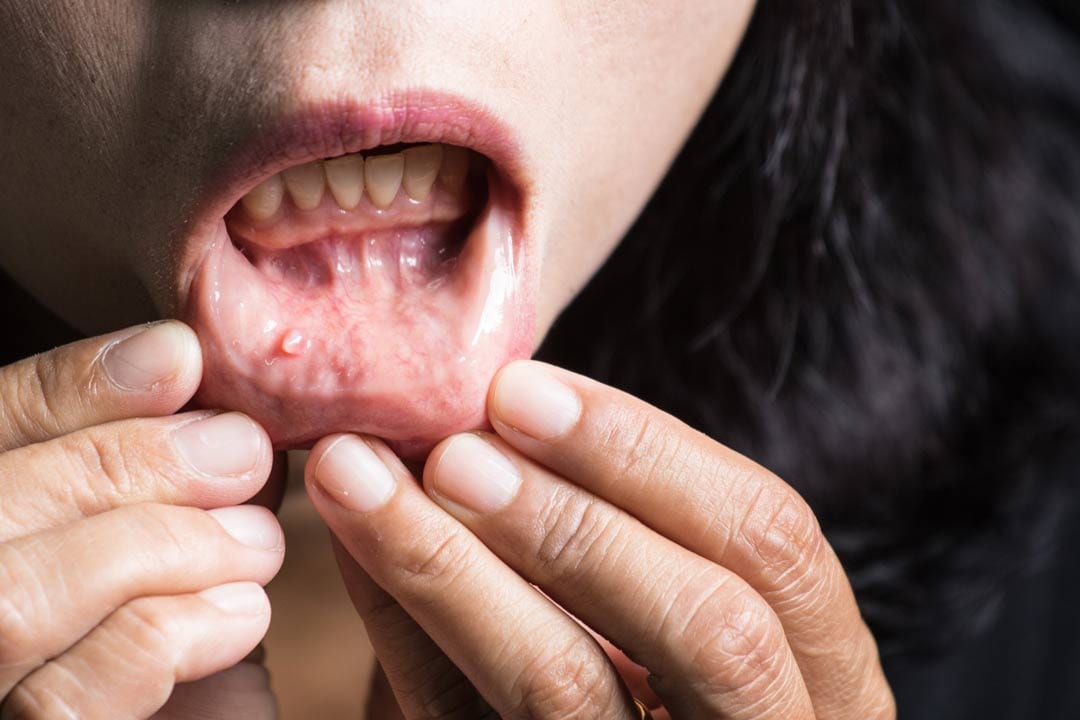
One point many people find surprising: ordinary ulcers usually hurt because they are inflamed. Early cancerous ulcers are often painless, which is exactly why they get ignored. Specialists at Singapore General Hospital and the National Cancer Centre Singapore highlight a painless, non-healing ulcer as the sign that deserves the most attention, not the least.
Oral screening is part of every routine checkup.
Check your mouth in 60 seconds
A simple monthly self-check in front of a mirror, in good light:
- Look at your lips, inside and out, and the gums around your teeth
- Pull each cheek outward and check the lining for patches or lumps
- Stick out your tongue and inspect the top, both sides and underneath
- Lift your tongue to the roof of your mouth and check the floor of your mouth
- Feel along your jawline and neck for any lumps or swollen nodes

Anything that looks different from the surrounding tissue and is still there after two weeks is worth a professional look. During a routine dental checkup, your dentist examines these same areas as part of a standard oral screening, which is why keeping up regular visits matters even when nothing hurts.
Who is at higher risk
Mouth and throat cancers are uncommon in Singapore, with head and neck cancers accounting for around 800 new cases a year. Risk rises with:
- Tobacco in any form, including chewing tobacco: the single biggest risk factor. Smoking also damages gums and teeth in ways that make problems harder to spot; see what smoking does to your teeth and gums
- Heavy alcohol consumption, which multiplies tobacco-related risk
- Betel quid or areca nut chewing
- HPV infection, an increasingly recognised cause of throat cancers
- A family history of head and neck cancers, and a diet very high in preserved foods
- Chronic irritation such as long-term gum infection or poorly fitting dentures
Singapore clinicians have also reported a notable rise in tongue cancer among women aged 35 to 55 in recent years, so these signs are not only relevant to older men who smoke.
How to reduce your risk
- Quit smoking and avoid all tobacco products; risk falls steadily after quitting
- Keep alcohol moderate, and avoid combining heavy drinking with smoking
- Avoid betel quid and areca nut entirely
- Ask your doctor about HPV vaccination, which protects against the strains linked to throat cancers
- Fix sources of chronic irritation: treat gum infections and replace poorly fitting dentures
- Keep up regular dental checkups so changes are spotted early
Why early detection changes everything
Caught early, treatment is simpler and outcomes are far better: five-year survival for early-stage tongue cancer is around 70-80%, falling to about 50% once the disease is more advanced. Early lesions can often be treated with minor surgery; later-stage disease may need major surgery, radiotherapy and chemotherapy that affect speech and eating. Two weeks of watchfulness against years of difference is the trade.
This page is general information, not a diagnosis. If you notice any of the signs above, see a dentist or doctor promptly.
Worried about a sore that will not heal?
Oral screening is part of every routine checkup at our Suntec City, Marina Square, Marine Parade and Tanjong Katong clinics. We’ll get back to you within 24 hours.
Frequently asked questions
How do I tell a normal ulcer from something serious?
Normal ulcers hurt, have smooth edges and heal within one to two weeks. Be cautious of an ulcer that lasts beyond two weeks, has irregular edges or a hard lump beneath it, or is painless. Those need a professional check.
Does a dental checkup include mouth cancer screening?
Yes. During a routine checkup your dentist examines the soft tissues of your mouth, tongue and throat entrance for suspicious patches, ulcers and lumps, and can refer you to a specialist quickly if anything needs a closer look.
What happens if my dentist finds something suspicious?
You will be referred for a specialist assessment, usually with a biopsy of the area. Most referred lesions turn out to be benign, but a biopsy is the only way to know for certain.
Is mouth cancer common in Singapore?
It is uncommon. Head and neck cancers together account for roughly 800 new cases a year in Singapore, and tongue cancer alone about 80. The concern is not how common it is, but how much better the outcome is when it is caught early.
Related reading
Sources: National Cancer Centre Singapore, HealthHub Singapore.